A few weeks ago, I was overtaken by a compulsion to walk outside my house, get in my minivan, drive to the house of every single person reading one of my essays online, and murder them. The compulsion took me by surprise by its level of violence, its ridiculous plan for carrying it out, and the confusing victim criteria. People reading my essays online? What? Why? But I’m not told why, just how.
Here’s the scenario. One of my readers is sitting at a table or desk in front of their computer or laptop reading my writing. It is nighttime. Suddenly, I burst in through the front door, grab them from behind, pull their head back, gouge their eyes out with a spoon (?), and drag them, screaming and bleeding to my 2006 Toyota Sienna where I shove them inside and close the door. Once on the road, I put on “I Took A Pill In Ibiza” by Mike Posner (the Seeb Remix). I turn up the volume to exactly 100 decibels, roughly the level of a Dave Matthews concert.
I drive my minivan and passenger to a specific public access parking lot in Virginia Beach, where I lived when I was a teenager. Once parked, I turn the music off, slide open the door, yank the reader out, and frog-march them across the parking lot to the ocean’s edge. I then shove them to their knees, sideways-kick them between their shoulder blades onto their stomach, climb on top of their prone body, and using both hands, full of violent strength, grind their faces into the cold, wet sand until they die.
Pretty horrifying, right? I don’t recognize myself in any of this.
For one thing, I’m not getting in my minivan and going anywhere — it hasn’t worked in years. It’s been parked next to my house so long it feels like the seed car for a yard-full of dead vehicles. And, no, I don’t have alternative transportation for the field trip(s). I replaced the Sienna with a 2017 Lexus RX 350 SUV, blue with tan leather seats. It’s the newest car I’ve ever owned. It has a backup camera, perfect temperature control, and it can both warm up and cool down the seats. I’m not shoving a bleeding person into my pearl-blue perfection; I can’t imagine how hard it is to get blood out of perforated leather.
Look, I’m happy to kill people, but I’m not happy to look like an idiot. This plan is guaranteed to find me on YouTube in a police interrogation room trying to explain a decibel reader on my dash, twenty witnesses who saw me dragging someone across the beach-access parking lot where, coincidentally — I swear! — that same person is found dead by the water’s edge. Next, true crime fans on YouTube will watch the detectives play me a video from a neighbor’s Ring camera. There’s my van. Another neighbor’s camera shows you my perfectly anonymous license plate IMISMOM. A third one shows “I Took a Pill in Ibiza” playing so loudly an impromptu rave has sprung up in the street. Imagine the shit I’d take in prison for this bullshit.
I can’t prove it, but I am convinced my compulsion was involved in the genius murder plan of Nicolas Kassotis who killed his wife, Mindi. I just watched his trial. Spoiler alert, he did it. Mr. Kassotis killed his wife at home and then disposed of her dismembered body in five plastic bins on five separate trips to the 13,000-acre Portal Hunt Club, forty-five minutes from his home. He was captured on so many cameras on his trips to the site, it was like watching a movie.
But the pièces des résistance for the prosecution were, first, his shopping trip to Bass Pro Shop the day after the murder where he bought a deer processing kit, a hunting knife, and a shovel using his own credit card. The other pièce was a video of him in Home Depot, the day after his trip to Bass Pro Shop, buying a knife, a plastic storage bin, folding razors, and Clorox wipes. I’m guessing he used his loyalty card. Just like every other rich murderer, he went to trial and then put himself on the stand. He explained the purchase of the deer processing kit as a Christmas gift for his nephew. In part of the cross, the prosecutor asked him if it was a present for his nephew, where was it now?
I think the free-roaming murder compulsion needs to watch some true crime and learn that violent, impulsive murders lead to dead bodies and lots of blood. At least his plan tried to deal with the body by cutting it up, putting it into bins and putting them on hunting land. My plan leaves bodies out on the beach and a van full of blood from eye wounds. Ironically, Kassotis’ first “tote” was found a few days later by deer hunters. At least I think that’s ironic. Don’t come for me, you Alanis-Morrisette-buzz-killing English major bitches.
Also, I love logistics and this plan has none. How do I find these people? How do I know when they are reading something? What about readers in Kansas? There’s no beach there at all, much less a specific parking lot next to a specific beach – am I flying? With a real ID? Driving my “IMISMOM” labeled van? Do I have to do them one at a time? How do I keep them quiet in the van? Do I clean out the van between murders? How do I buy gas? My Visa?
Despite all of this insanity, there is an even bigger flaw in the plan: Nothing I’ve written is online. This compulsion came at the thought of putting something I’d written online. I can’t imagine what it wants me to do now that I am here and you are reading this. I can tell you it took me essentially a season to write this welcome page because I don’t want to complete it, I know what that means. People. Even if it’s just one person, just you, that is more than enough to make us want to open Spotify and get out my decibel reader.
There are a lot of reasons nothing I’ve written is online, but one is the dread I’ve had since I wrote my first story in high school: if people read my writing and like my writing, they are going to want to talk to me about it, maybe on tv. This was a long time ago, so the only real threats were local morning news shows and Phil Donahue, but still, I worried. It’s not that I’m shy, but I have a looming dread of having a constructed experience where things are fake and insane but everyone is expected to pretend like they aren’t. In the constructed scenario of my early teen years, I was the only one in my family unwilling to pretend like things were normal. My stepfather lamented at me a thousand times, “get with the program.” My unwillingness to do that landed me a summer-long stint in a psychiatric hospital when I was fifteen. A stint I enjoyed, by the way. Things were much more normal there.
In high school, I hatched a plan for this non-existent media problem. It involved using not just a pen name, but a pen person. My friend, Doug Heller.
Doug had been kicked out of his house when his father found out he was gay. He was taken in by a deranged matriarch (I think named Carolyn) with a skin condition that left her face covered with strange bumps mixed with jagged pockmarks. I realize now Carolyn must have been getting a check from the city for taking Doug in, but I had not yet been a foster parent and so had not met random insane women who collected wayward young men for the city check.
One woman I met years later was a master of getting these young men disability checks when they turned eighteen and once she did, they direct deposited their checks into her account (for safekeeping) and she would give them a bleak, shared space to live in at her house and then handing over weekly spending money left over from their “rent.” Her main job though, was lawsuits. She brought them against every store she could. She had accident after accident in their unsafe aisles. She was also a Christian and held bible study at her house each week her “tenants” had to attend. I would bet every single dollar I own she’s wearing a red baseball hat right now.
Anyway, Carolyn, the wonder of maternal love, gave Doug the nickname Fag Pop. When she was angry at Doug, she would call him a faggot, but Fag Pop was said with affection. Carolyn had a daughter named Nancy who went to the school Doug and I attended. Whenever Nancy used Doug’s nickname, she would end by putting her finger against the inside of her cheek and making a popping sound. Nancy was the dumbest person I’ve ever met. Every day after school, she would come home, get a snack and go up to her room to do bong hits and watch soap operas on her little tv. I was there everyday after school, too. It’s where Doug lived. Nancy and Carolyn were just bonus attractions.
But there was a problem in paradise. A basic algebra class stood between Nancy and high school graduation. She’d tried many times, but now it was a real threat to her diploma. Unfortunately, Carolyn found out I was good at math. One day out of nowhere she told me I was going to teach Nancy algebra so she could graduate. Failure (both Nancy’s and mine) was not an option. If she didn’t pass, there would be violence. I don’t know why I didn’t just stop going to Nancy’s house, but it was like being on the Jerry Springer show and it wasn’t like I could sit at my parents’ house and do bong hits after school. Nancy passed the class.
Years later I saw Carolyn on the actual Jerry Springer Show, she looked and acted exactly the same. I can’t imagine how excited she was to be there.
In the middle of all this, Doug was shining light of fun, kindness and the kind of guy who would ask you to wait for him to get his shoes if you told him you were going to do something that would, at best, lead to a night in jail. Doug and I made a pact. When the time came to publish my writing, I would do it under his name. My dislike of attention was matched and multiplied by his love of it. And he deserved attention. He was awesome. It was a perfect plan.
Alas, I was in my mid-thirties before anyone I didn’t know read my work, much less called me/Doug to be on a talk show. I was living in New York City at the time, working at the medical examiner’s office in Manhattan in the aftermath of 9/11. We were in charge of getting families of the victims death certificates without remains, receiving, cataloging, and identifying the 20,000 remains that came to our office from Ground Zero and the Fresh Kills Landfill in Staten Island where debris from the site was brought and sifted through trays to make sure nothing human was tossed out with the wreckage.
This was, of course, something of a fool’s errand, but how could you not try? Do you want a part of your son’s femur sitting on a heap of destruction at a landfill named “Fresh Kills?” The name came from the Dutch word for waterway and the fresh part means freshwater. Fresh Kills estuary was by Staten Island. Someone thought it would be a good idea to name a landfill after it. Knowing the nature-y background of the name did not help me, or anyone I worked with or any family member I met. When remains were identified through DNA, we knew whether they came from Ground Zero or the landfill.
Understandably, most families wanted to know as much as possible about the smallest fragment of tissue we identified. They had nothing else. Often it was my job to tell them. Over the phone. In person. There I would sit. Yes, we found your mother’s trachea near the footprint of the north tower. That trachea nearly killed me. I felt like we’d found her mother’s voice. How did they survive that? How did I? Thinking about it makes me want to take my hands, full of violent strength, and grind someone’s face into the cold, wet sand.
Maybe a year-and-a-half in, 2003, I had enough time and space to follow a life-long desire and took a non-fiction writing class at The New School. I was so excited. It was a dream. The professor was a long-established writer you might have heard of and an intimidating, judgmental bitch. I loved her.
After a brief talk, the professor would stand at the head of two conference tables pushed together with us around her in a ring. Each week, a different set of us would bring in work to share. She would read our work out loud, anonymously. When she was done, every week after every essay, she would look up and ask, “Were you there?” as a way to start the discussion of the person’s writing.
When it was my turn, she read this:
After Hours
Thirtieth Street was closed to the public between First Avenue and the FDR. Security staff from the medical examiner’s office demanded identification from anyone trying to enter. On First Avenue, double-decker tour buses passed by, filled with tourists struggling to glimpse Memorial Park, the massive white tent at the end of the block. Over the traffic, you could sometimes hear the words “World Trade Center” as the tour guide explained what they were seeing.
On the east end of Thirtieth, just inside the barricade, was an ugly, dirt-brown trailer on cinder blocks. This was where my office moved after leaving the conference room. Officially, the trailer housed the Incident Command Center, World Trade Center Operations, Office of Chief Medical Examiner, City of New York. It was a shabby, smelly hut with an overblown name.
The night Hurricane Isabel was moving across North Carolina, I was working alone in the trailer. I could hear the wind outside, but inside it was calm as the room and I recovered from the chaos of the day. I was staring at my computer screen, surrounded by piles of sky-blue folders, when the phone rang unexpectedly. We’re closed, don’t answer, I thought, as my hand reached for the receiver.
“Medical examiner’s office, this is Katie.”
“Hello? My husband died on 9/11. I’d like to make an appointment to visit Memorial Park. Can I still do that?”
“Of course,” I said, and we scheduled a time for the following Friday.
“Is there anything else you need?” I asked, and as she replied, I noticed her accent for the first time. “My friend called and told me you were done with your work. That means you’ll never identify my husband? I cried when she told me. I don’t know what I’m going to do.”
“Oh no,” I said. “We’re not done. We have at least another year to go. And when we finish, we’ll let you know. I promise we won’t just go away. We identify a few new people each month, and we hope to identify at least a hundred more before we’re done.” She told me where her husband worked, what floor he was on. I told her we had identified people from his company, from his floor, even from the impact site of the building he was in. “You have to be realistic,” I said, “but there is hope.”
She started to cry again. “Thank you. Thank you. I was so scared you had stopped trying.” She told me that each night when she prays the rosary, one bead is for the people at the medical examiner’s office. She prayed we would have the courage to continue working. I thanked her. I told her we needed her prayers. She asked to meet me when she came on Friday. I had to spell my name twice; she had trouble writing it down. We said goodbye, and I went back to work, both of us relieved I had answered the phone.
I remember the professor looking up at me while she stood at the end of the table reading; I don’t know how she knew it was mine. When she finished, she asked everyone, “Were you there?” But they weren’t. They were somewhere else, answering a different question: “Where were you on 9/11?” I sat and listened while people talked over each other telling stories of that day, where they’d been, what they’d seen, what connections they had to the towers or people who died.
I’d come to New York shortly after 9/11 and I remembered how things were. Everything felt empty. Missing posters were stapled to every available phone pole. Everyone was walking around with “What the fuck” expressions on their faces. I knew there was a lot of unprocessed trauma for New Yorkers from 9/11. In some ways having spent the following year and half focused only on the World Trade Center was the more appropriate response than just waking up and now it’s 9/12, but still. I felt like a starting point for other people’s experiences. I was not there. Just my words.
In the end, though, there was a different problem for me. In the next essay read out loud, a woman beautifully wrote about her experience of being raped by her grandfather during her childhood. He took her to the basement to do it, and her dog stood at the top of the stairs whimpering and letting out stifled barks. I was there. We were all there. I still hear that dog. I never went back.
Years later, after leaving New York and moving back to my hometown of Richmond, I would again watch my words launch someone else into their own world, leaving me behind in mine. When trying to find a therapist to help with the crashing case of PTSD and depression that fell on me when I left New York at the end of the identification project in 2005. Sitting with a new person, I would start to talk about something that happened and they were gone, lost in their own version of 9/11, and feeling something creepily exiting, being so close to it all by listening to someone who had been there.
They were greedy to know more about what I had seen and done at the same time putting me on a pedestal – I can’t imagine how you did that. It must have been horrible. I could have never done it. What a gift you gave those families. The first one I saw said, “Oh, it’s so crazy you’re here. My friends all call me Dr. Death because death just surrounds me.” I’d like to go back and see her in my minivan.
I was right in high school: it wasn’t enough for people to know what I had done, they wanted to talk to me about it. They wanted more.
I continued to write after arriving in Richmond with my husband. I signed up for a writing class at the Virginia Museum called “Writing the Shadow,” taught by a different, lesser Doug than my friend who wanted to be a star. Doug was greasy with neurosis and self-doubt, while concurrently thinking he was the most amazing person in the world.
During the class, we would bring in copies of our work (eight people, maybe), read our work out loud, and then we’d talk about it as a group. I think that’s how it worked. Who knows. Other than gross Doug, the other thing I remember is a woman named Farrah. She looked totally normal, like a woman who had a nice garden and drank tea. As part of the class, we’d be told by Doug that if we ever got stuck while working on an essay, to type “what I really want to say is…” So, halfway through reading her essay, Farrah said those words, and I think we all wish she hadn’t.
What she really wanted to say was that her husband, who had gone to someplace like Thailand a few years before, had slept with a prostitute. He came home and told her. I can’t remember much, but I know after his return he became obsessed with the idea he had gotten AIDS or another STD or disease. Obsessed. He fretted and moaned about it all the time. I think it was years at this point? She was putting up with it; I can’t remember why. I do remember thinking at the time: 1) This woman is batshit, and 2) Her husband needs to be tortured and shot.
After the eight weeks of the class, some of us decided to continue on as a group and hired the bad Doug to continue as our leader. We met for years and years. We met at my parents’ house for part of it — they had a dining room where everyone could be seated comfortably. My mom loved us being there. I don’t remember much about our meetings in Richmond. I was drenched in trauma and not laying down normal memories. I can see us in a room, but it’s a movie with no sound. It doesn’t help that I did three rounds of ECT during that time, and that can affect your memory, but I don’t remember if it affected mine or not.
I do remember looking up at the group when I finished reading one of my essays. They looked like they had been hit by a baseball bat. Stunned. Eyes big. I remember that feeling so good, like yeah, they were there, and by sharing the horror I had helped dilute it just a bit. I wrote and wrote and wrote. I attended the Tinker Mountain Writer’s Workshop twice and again, it felt good to say things that felt unsayable. It felt good to be able to say it well enough to hurt. Other people, that is, not me.
When I moved to Leesburg from Richmond in 2019, the group stopped meeting and I stopped writing. Deadline and commitment matter. At that point, all the essays I’d written were strewn across different hard drives, cloud drives, and zip files. There were endless copies of the same document, drafts of essays and files that looked like they had an essay in them but were empty. I tried multiple times to collect and organize, but it just made it worse. And so, it all sat until about a year ago.
Recently Mike and I started meeting again, monthly on Google Meet. With the deadline back, I started to write again, even if it was in a frenzy the day before our time together. I wrote an essay about another plane crash in New York City in 2001 and how seeing the ICE raids was triggering my PTSD.
Airlines Flight 587, headed to the Dominican Republic, crashed on November 12, 2001, two months after 9/11. Just minutes after takeoff, it dove into the ground in a neighborhood in Queens. Two hundred and eighty-seven people died. I was part of the response of the medical examiner’s office to the Jacob Javits Center where families of the victims were instructed to gather so we could collect their information and get anything that could help us with the identification of the bodies.
The vast space was full of light and crystal windows. It was still not big enough to contain the grief and horror. The reason you don’t remember this crash is the same thing that made the pain so big: everything was happening in Spanish. I have talked to many people about many horrible things and there is often great pain, but pain is mitigated by the words you are speaking and hearing. They give you something to think about, a distraction. In the crystal cavern of the Jacob Javits center, I did not have that mitigation and it was a blanket of sound pressing into my heart and soul, squeezing them hard, releasing, squeezing again. It was hard to breathe. It still is.
I don’t know about other people who worked on the response to 9/11 at the medical examiner’s office, but I tend to blank out Flight 587. There just isn’t room for another plane crash in the story of what we did. And because the plane wasn’t headed to Paris or Idaho, there’s no reminders of it, there’s no cultural memory connecting a third flight just two months after.
I only thought about Flight 587 when I realized my PTSD had gone into overdrive and finally figured out it was seeing the ICE raids – anguished families. Horror. People disappearing out of nowhere. Knowing the grabbing of the person was just the beginning. Who knows where he’s going? Who is going to tell the family? It was (is) a nightmare of loss and grief. All in Spanish.
Because the crash of Flight 587 was blanked out of my mind, it took time for me to realize I was even getting re-traumatized. But when I did, I thought nothing we do intentionally should sound like the aftermath of a crashed plane that created a firebomb that burned the bodies of dead parents and children and left everything reeking of jet fuel. How can we do that on purpose?
When Mike suggested publishing, I had a thought. Maybe my work could help somehow. I could be, as John Irving wrote, of use. I recently read a Facebook post about how to cope with the horrible world we’re living in right now: focus your efforts where your position to help is unique. As a father, you are in a unique position to help your son or daughter. A teacher and her students. One partner to the other. Maybe my words could help someone. A reader. Online. That started the journey to this essay on this site.
Another step forward came from Claude, the AI. I recently spent dozens and dozens of hours with Claude while researching family history for another project. Claude helped with research. It made connections I would never have found. It also helped me keep everything organized. I knew to use it carefully. I always keep the slogan, “God grant me the confidence of a mediocre white man,” when I’m doing work with AI. Those connections it makes? Sometimes they’re bullshit, sometimes they’re gold.
So, when I finished the project on my family history, I used it to take all those essays I’ve written over all the years from all the folders, drives, online storage, and zip files and organize them. This is something I’ve been wanting to do forever.
One early benefit: it made it possible for me to find the essay from The New School by only remembering the last line. Part of the problem I’ve had with organizing it over the years has been not wanting to read it. Part of me believes, knows, the way you know things in dreams, that each file is packed with suffering I may have forgotten, like Flight 587, and reading them will either kill me or remind me I’m already dead.
Working with Claude, though, I didn’t have to read any of it. He told me to first collect all the files into one folder from all the scattered shadows they’d been living in. There were 3,000 of them. Claude told me to run a duplicate program, telling me how to tell it to look for exact duplicates while also ignoring the name of the document. That eliminated 1800 files. After that, he taught me how to use Python scripts. He would create them and I would run them. Doing this, Claude took the contents of any file with less than 500 words, put those words in one big document and deleted the individual files and put them in one big Word document.
Then he wrote a Python script that looked in each document and read the first forty lines. Things that weren’t essays were removed. Unique essays were put in a folder. Essays with multiple drafts were collected in a folder with the name of the folder being the name of the essay. It took hours. Days. This is the final list of folders with multiple drafts.
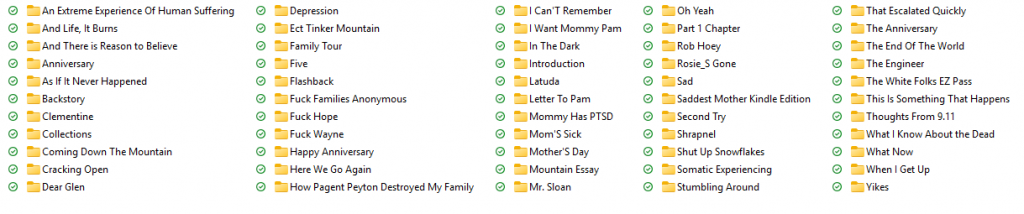
Here are the 64 unique documents.
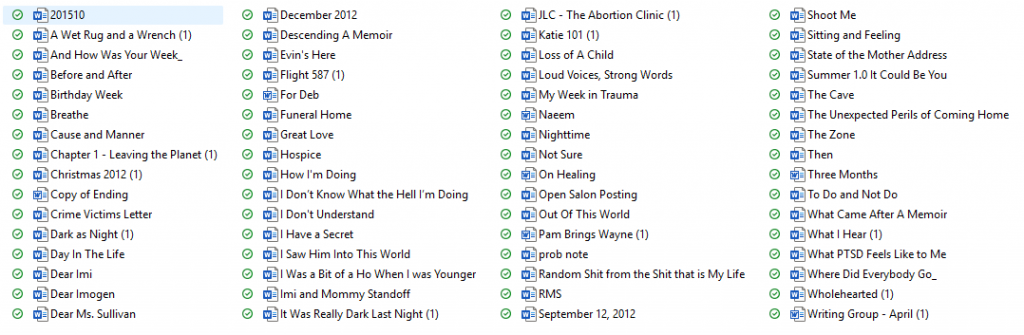
There are 257 Word documents all together. When I’m done getting it all figured out, which I can’t do right now because it’s radioactive, I’m guessing there will be around thirty complete essays. Maybe more. I hope it’s not more, but it might be. All of my writing being pared down to these files and folders changed my relationship to it.
There is relief that these thousands of files are no longer spread out everywhere, that there is some order. Maybe I can do something with it now. But the order creates my first capability to actually see it all in one place. It feels scary, but at the same time, maybe I can be of use to myself. Maybe I can discharge some of the energy, maybe I’ll find out I survived.
Another barrier that came down was figuring out how to do it. I’ve struggled with this forever. Substack seemed like an idea, trying to get things actually published? But all of these thoughts brought me back to my old dilemma: if people read it, they are going to want to talk to me about it. I don’t want to talk about it. At all. With anyone. And there’s a lot more than morning news shows and Phil Donahue now. I can see myself on TV with someone leaning in asking, “Tell us about something that happened that has really stuck with you.”
That’s a made-up problem, though. I’m not likely to become famous enough for a bad podcast, much less one of Oprah’s meaningful outdoor conversations with good lighting and earnest white people circling around. Plus, fuck Oprah.
A real problem, though, is not chatting or being probed for trauma porn, it’s that when people hear hard things from someone, it can make them feel safe to tell their own stories. I cannot risk people telling me sad things, I’ve heard, seen and done too many sad things; I don’t have room. I can’t hear any more dogs.
Eventually, I realized I could just put it on a web site. Like this one. I can do it with comments turned off. I already owned this domain for something else I’m working on, and so I made up my mind to use it. Or at least to think about using it.
The final push was Lisa, more specifically, her death.
I have a rare form of Lupus that causes inflammation in my brain and spinal cord. When I finally got diagnosed, the neurologist started me on weekly home infusions of IVIG, some fluid containing plasma, I don’t know that much about it. It helps with inflammation.
Lisa was my first infusion nurse, and she came for four hours every Monday, for over a year. She’d hook up my IV and we’d sit and talk or watch a movie. Often, I slept. Lisa and I were the same age, both educated, both progressive. At the time I was in a deep dive into the study of German concentration camps and the Soviet Gulag, the name for the government institution that force-populated and ran work camps. She knew as much as any WWII historian. I was impressed.
Lisa had been a labor and delivery nurse for decades and then switched to doing home infusions. She was one of the loneliest people I’ve ever met, despite her marriage and four adult children. I was her best (I think only) friend. She looked forward to coming every Monday. She told me everything, including a lot of things no one else knew. I would happily never know anything about anyone that no one else knows, but people keep telling me.
Lisa started to get heart palpitations, finally went to the ER, they ruled out anything acute and told her to follow up with her primary care doctor. She did not have a primary care doctor, and she would not get one or go to any doctor at all. I tried to get her to go to Patient First, but she wouldn’t do it.
I tried to get her to find a primary care doctor near her house, but she wouldn’t. Here are the main reasons: 1) I had three babies on my own with no medical intervention (the fourth child was adopted), and I’m not going to be a big baby myself; 2) if I go in and they find something, I’ll be swept up into the medical world and forced to do things I don’t want to; 3) my mom was a hypochondriac; 4) they won’t be able to find anything wrong; 5) it will go away on its own.
I bitched at her every week. I made her promise. I told her she was a fucking idiot (she liked that). Then she was struck down by fatigue. I know about fatigue. It is not being tired; it is too much gravity being poured on top of you so you can’t lift your arm. She missed a week, letting me know beforehand. Then she missed two more weeks; this time it was her supervisor who let me know. Then she came again.
She was so clearly wiped out. I told her she needed to go home; she told me she wanted to see me and she wanted me to have my medicine. I talked to her during the entire infusion. I pulled up a primary care doctor online by her home that had an appointment that afternoon. She wouldn’t do it. I told her if she didn’t see one she couldn’t come anymore. “Really?” “Yes, really.”
The next Monday she did not come and did not text ahead of time. I knew she was dead. I kept texting her supervisor asking about her, and she kept putting me off, then wanting to talk by phone. Finally, the supervisor and some corporate guy called me. They said, yes, she had died, and it was just so surprising, out of nowhere.
Hearing she was actually dead was a breaking point for me. Who knows why it was this. Bizarre, deadly, high-trauma events are so common in my life, it’s boring, but this one set me off. I went out to my car to call my best friend and my brain was screaming: ENOUGH. ENOUGH. ENOUGH. STOP. STOP. STOP.
I was standing in my gravel driveway, next to my Lexus, near my dead minivan, filled with rage. I hated her. I told her she was going to die, I saw her dying, and then she did it. What do I do with that? Where do I put it? I didn’t feel responsible for her death, fuck that, I was furious that she had brought death so close to me again. How can that be?
Well, one of the ways it could be is it wasn’t the first time it happened. I had a student in an introductory sociology class who, looking back, reminds me of Doug Heller, my pen person. He was sweepingly gay and was always the center of attention, but the focus was on the word center.
He lit our class from the inside; we were all warmed along with it. I’d never had a class with a star before or since. He made us laugh with pithy comments and sharp jokes about his conservative family whose Christian-dipped disgust disapproval were so strong we could feel it. How could they not be proud? How could they not adore him?
He was sick, one of the issues was diabetes he’d had since childhood. He walked on crutches; he swung himself around on them – his left foot had been amputated right before the term started. He sat in the front row of the small classroom, just on the aisle. The chair waited for him happily between classes.
In class one day he was clearly not ok. He looked so tired, so drained, so sick. I told him he needed to go home, he said he would. I asked him how he would get home; he told me he’d call his mother. The same woman that would make his funeral feel like a starched, blank play put on about the son they wished they’d had but didn’t.
After class I found him in the space outside the classrooms, sitting in one of the couch-like chairs, looking like he was sleeping. I told him to meet me downstairs; I was going to get my car and drive him home. Oh God, I just realized it wasn’t a car – it was my minivan.
On the way to his house, we drove right by a hospital, I asked him to let me take him. I remember looking at the emergency department sign as we drove by, aching to turn in anyway, but I didn’t. He told me to take him home; his mom would help him. I helped him out of the van and down the sidewalk towards his front door where his mother stood by the open front door.
Student services called me the next day and told me he had died. Unlike with Lisa, I was shocked and surprised. I knew something was very, very wrong. I knew there was something in the car with us, something that still has me staring at the emergency room entrance sign on the road as we passed, but I hadn’t called it death.
I had to go back to class the next day and break everyone’s heart. We didn’t know what to do, but we didn’t have to pretend to know, instead we sat and talked about him and the ache we all felt. My friend, an artist, listened to my sadness and had an idea. I had anyone who wanted to bring in an object or note that reminded them of him. We had a picture of him; I can’t remember how.
My friend created a picture box, his picture surrounded by her art and our objects and notes. I brought it to class every day for the rest of the semester and put it on the table in front of his empty chair. I just panicked thinking about it – what happened to that box? Do I have it? Please tell me I don’t have it. I remembered, though, his friend who was in the class asked if she could take it home.
I don’t feel responsible for his death, I don’t think I could have saved him. But I am glad I was there on the way to his death. I’m glad I told him to meet me downstairs. I’m glad he had someone who loved him bring him to the place where it felt like no one did. I’m glad I was of use. But it aches. I feel the same way about 9/11. The same way about Flight 587. The same way about my life. Everything hurts.
But knowing him feels like a gift, knowing Lisa feels like an attack. She took and took from me and then came to my house to die. And the most painful, the holiest part, of Lisa’s death involved another dog. Not a dog at the top of the basement stairs, but my dog, Blue. Blue is a 100-plus pound mixed breed with Husky-blue eyes. His main characteristic is goofiness.
Blue liked Lisa, but after a while, he’d lay down and sleep for most of the infusion. The day before she died, he didn’t, he spent the whole time laying across her lap, like a living weighted blanket. She could not get rid of him. She could not push him off. He stayed; despite the yoga she had to go through to get the infusion ready while getting the infusion ready. She was so tired it would have been hard anyway, but he didn’t budge. When she would settle, he would settle, laying across her, his head resting on his paws, his eyes open.
Maybe you see it, but I didn’t. I didn’t realize it until later when I told my daughter about Blue and she said the obvious: he knew.
Of course he did.
When I found out Lisa had died, when they told me on the phone what I already knew, when I went outside to call my friend, I was full of anger. Anger at Lisa, anger the universe, my universe.
Unlike after, while I was in New York at the medical examiner’s office, I did have a therapist who was not a lunatic. I saw him twice a week when I was working there. He once asked me, “Did you ever notice when you go to your annual professional conference, you’re the only one there? He was smiling, but he was serious. And it wasn’t just New York, it’s been my life – experiencing things that no one has ever heard about and responded with, “Yeah, that happened to me, too.”
Lisa, though, didn’t have to happen. She worked to die. And she made me watch. Alone. With my dog. She left me with an insane story – what do you mean you’ve never had your nurse die the night you yelled at her that she was going to die? I have enough insane stories to tell, thank you.
In my driveway, walking to my car to call my friend, I felt the first appearance of the compulsion. My hands clenched with the desire to take Lisa’s face and grind it into the gravel.
I had been using Claude to sort my words without me having to read them, but just like after Flight 587, the lack of words left me alone with the ghosts that swirled out of each essay as they were read by someone else, something else, right in front of me. Those ghosts were around me in the driveway, as was the idea of looking into their eyes.
My thoughts of publishing, of releasing the ghosts outside of myself, filled me with feelings of vulnerability and sharp joy. Here, you take some of this, let me use my words to draw you into it, to put you there, then leave. See how you like it. See if you die. See if I’m still alive.
For some reason, though, the compulsion wants to kill anyone who reads my work, who sees the ghosts around me, who hears my stories despite the words. It’s also the reason it has taken me months to write this stupid welcome page. It goes up to 7,000 words, the longest thing I’ve ever written. I hack out paragraphs, then write new ones. I’m back up to 7,000, passing by it now.
I don’t know what I’m going to do with this site. My plan is to add more writing. My hope is that no one reads it. Maybe I can just release it, and it will crackle in the world, discharging energy, letting me breathe. Maybe someone will find it of use.
I told my writing partner Mike I was going to put this up, and I’m mostly a woman of my word, even if I’m months overdue and thousands of words are behind me, thousands more to go.
Here it is. Here you are.
Sitting at your computer, maybe? Reading my words? Is it dark outside?
You might want to get a Ring.
Woof.
DHKS
Summer 2026
Many thanks to Claudia Brookman, the person I most wanted to read this before it went online.
All errors are mine.